Blog

  • Eye of the Storm

    Eye of the Storm

    After working with a client recently on his emotional stress reactions, he had an image of being at peace in the eye of a storm with a growing white protective bubble around him and the dark clouds receding farther and farther out. With time and practice, his intention is to make those dark clouds less dense so the space of peace expands farther and farther.

    This is a powerful image and one that came after entering the storm and discovering that by facing it with courage, presence and compassion, he was able to discover a peaceful center that was there all along. His mind and body were caught up in the whirl of the storm, however and he didn’t notice it.  The photo is taken from the eye of Hurricane Dorian. Amazing image!

    In the eye of the storm
    You remain in control
    And in the middle of the war
    You guard my soul
    You alone are the anchor
    When my sails are torn
    Your love surrounds me
    In the eye of the storm

    Lyrics by Ryan Stevenson

    Our nervous system was designed to handle occasional stressors with the fight or flight response; major threats with the freeze response. The rest of the time, our system is supposed to be in the “rest and digest or rest and repair” mode. This ensures the health of our whole system. Challenges are balanced with times of recovery.

    Lately, the challenges keep coming and we aren’t handling the stress so well with mental health issues on the rise. Our old ways of coping aren’t working or not possible.  The nervous system is calmed through supportive social connections which are not as easy to do safely now.

    So, how do we find that peaceful center?  It takes discipline and practice. Our minds are on high alert so it will be like taming a wild horse but start we must as we are in an era of great change and chaos.

    Find Your Peaceful Center:

    1. Make time to just sit with yourself and breathe.  Connecting to the breath brings the mind back in alignment with the body and spirit. The Latin term for breath is spiritus. Notice you are being breathed. Relax into that awareness of a force beyond your understanding that breathes you and keeps you alive.
    2. Connect with nature. Nature shows us that everything is in motion and change; flowers bud and then whither, fruit ripens and then turns to seed. We are part of it all and when we notice, there is beauty and joy and also the understanding that we are not in control!
    3. Connect with your loved ones, especially now when we can be outside. Be a source of support for someone with a calm voice and listening presence.
    4. Find something you are grateful for and savor it – the brain loves to stick to negative things. We have to pay attention and savor for the brain to shift to the positive.
    5. A recent survey found that 70% of participants described themselves as spiritual. Use that belief or inner knowing as a source of support now. Relax into your inner knowing of a higher power.
    6. Give yourself the gift of moments of silence. That’s where the healing happens, that’s when the insights come, that’s how Grace works its magic, subtly and sometimes dramatically letting us know All Will Be Well.


  • The Stress Hardy Personality

    The Stress Hardy Personality

    Everyone I talk to these days is tired, distracted, and anxious. There is much uncertainty in our lives and much continued disruption. The definition of stress is: A response to any pressure or demand, requiring change or adaptation. Sound familiar? These are challenging times.   “Doom scrolling” is a new term for our times when you can’t stop scrolling through your news or social media feed and just can’t pull yourself away.  Well my dear friends, that isn’t helping!  I want to introduce to you today some old research from 1979 about the Stress Hardy Personality. Like the cactus in this photo, flowering despite inhospitable conditions.

    Life isn’t about waiting for the storm to pass…it’s about learning to dance in the rain.

    Dr. Susan Kobasa and Dr. Salvote Maddi did a ground breaking study in 1979 with  the executives of the Bell Telephone Company during a major restructuring of the organization.  They were curious about why some people seem impervious to stress and even thrive and others don’t.  What they found was that those with certain personality characteristics had 50% less stress related health issues. These hardy traits, known as the 3 C’s are:

    • Challenge:  Seeing stressors as opportunities for growth and change.
    • Control:  Having an internal locus of control, in other words, not being a victim to the external circumstances of your life.
    • Commitment:  To self, others or a mission. Your purpose protects you.

    They found about 30% of the population they studied had those traits naturally. We now know that these traits can be cultivated by practicing certain “stress hardy” skills.  The brain is changeable and we can learn to choose our thoughts and responses with practice and intention.

    Practicing stress reduction and mindfulness meditation will help you to develop these stress hardy skills:

    • Learn to pause and breathe before reacting.
    • Learn to observe your thoughts and not identify with them. You don’t have to believe your thoughts!
    • Practice daily self-compassion. What we are all going through is hard. Acknowledge that give yourself a break and some gratitude for all that is going right in your life.
    • Commit to a daily meditation practice. From a place of calm stillness, ask what’s possible now?

    For more inspiration and wisdom on this topic I highly recommend the beautiful and brilliant book, Man’s Search for Meaning by Holocaust survivor Victor Frankl.

    Everything can be taken from a man but one thing: the last of the human freedoms”to choose one’s attitude in any given set of circumstances, to choose one’s own way.

  • Accounts Receivable Financing Explained

    These invoices must detail the amount due and the payment terms, and they are then submitted to a factoring company. The accuracy and detail of these invoices are paramount as they form the basis of the factoring agreement. The factoring company reviews the invoices to ensure they meet all agreed-upon criteria, such as minimum value and clarity of the payment terms. This initial step is crucial as it sets the groundwork for the subsequent verification and approval processes. The cost of factoring accounts receivable includes a factoring fee, typically 1-5% of the invoice value, and possible additional fees for an origination or early contract termination. Costs vary based on the net terms, customer creditworthiness, and individual factoring company rate differences.

    The amount deducted in respect of such adjustments is usually refundable to the seller in case no event requiring such deductions arises. Rather than waiting for the due date, a company may quickly convert its receivables into cash by selling them to a factor for a fee, which is usually a small percentage of the total value of receivables being factored. As the due date approaches, factor meets receivables and collects full amount of cash. The difference between the cash collected from receivables and the cash paid to the seller company forms the profit of the factor. In this article, we’ll explain what accounts receivable factoring is, the types of companies that commonly engage in it, why it is beneficial, and how to find a suitable factoring company. But when credit customers are slow to pay, it can put a huge burden on accounts receivable with negative downstream impacts on cash flow.

    How to record factoring of accounts receivable?

    With accounts receivable financing, you’re using unpaid invoices as collateral to secure a loan or line of credit. In other words, accounts receivable financing uses unpaid invoices to secure another source of funding. By contrast, with factoring receivables or accounts receivable factoring, you’re getting a cash advance on your unpaid invoices. The factoring accounts receivable definition goes beyond a simple transaction; it’s a strategic financial tool that can significantly impact a company’s cash flow and operational efficiency.

    Detailed Advantages including Financial Flexibility and Cash Flow Improvement

    • AR factoring also enables companies to be in more control during the loan process compared to bank lending.
    • As you wait 30, 60, or even 90 days for payment, bills pile up, opportunities slip away, and growth stalls, creating a gap that can threaten even profitable companies.
    • This type of factoring is often used by businesses that have a long sales cycle.

    Understanding what is AR factoring in terms of its benefits and drawbacks can help businesses make informed decisions about whether this financial tool is right for them. It’s important to note that even in non-recourse factoring, the business may still be liable if non-payment is due to disputes over the quality of goods or services provided. Meeting these criteria increases your chances of qualifying for factoring and securing favorable terms from an accounts receivable factoring company. For instance, with an 80% advance rate, the factor provides 80% of the invoice value upfront, holding the remaining 20% as a reserve. This reserve helps mitigate risk for work in process inventory the factor while ensuring the business has a stake in the successful collection of the invoice. As we move further into the 21st century, the factoring industry continues to evolve.

    What are the disadvantages of factoring receivables?

    • Let’s further explore the benefits of receivables factoring and its potential positive impact on your business.
    • Make sure you evaluate your business needs, compare offers with us, and choose the best option.
    • Whenever someone is owed money, there has always been someone else willing to take a cut of future income in exchange for providing “instant relief” to the owed party.
    • After your customer’s payment, the factoring company will pay you the remaining 6% of the value of the invoice.
    • Before we dive into the calculation, it’s important to understand the key components involved.
    • By thoroughly understanding factoring accounts receivable meaning and exploring all available options, you can make an informed decision that best supports your business’s financial health and growth objectives.

    The integration of artificial intelligence and blockchain technology promises to streamline processes, reduce risks, and open up new possibilities for businesses looking to optimize their cash flow through factoring. In the 20th century, factoring receivables `became more standardized and regulated. The advent of computer technology in the latter half of the century revolutionized the industry, allowing for more efficient processing of invoices and risk assessment. The concept of factoring receivables has a rich history that dates back centuries. While the modern factoring accounts receivable definition might seem like a recent financial innovation, its roots can be traced to ancient civilizations. Finally, the factoring company pays you whatever remains between the amount you were advanced and the full invoice amount minus fees.

    Accounts receivable factoring can be invaluable during these times when companies need immediate cash flow without waiting for customers to pay invoices in full. Accounts receivables factoring is a financial practice where a company sells its invoices to a third-party financial institution at a discount for immediate cash. The factor collects payment from customers, and the company receives funding without waiting for payment or taking on additional debt. Managing cash flow effectively is one of the most critical components of running a successful business. For many businesses, particularly small and medium-sized enterprises (SMEs), cash flow challenges arise when there’s a gap between providing goods or services and receiving payment.

    The factoring company collects payments from customers, allowing businesses to focus on operations without waiting for customer payments. In accounts receivable factoring, a company sells unpaid invoices, or accounts receivable, to a third-party financial company, known as a factor, at a discount for immediate cash. When you factor accounts receivable, your company gets immediate payment for outstanding invoices to improve cash flow.

    However, non-recourse factoring means that the factoring company accepts those potential losses. Non-recourse factoring generally comes with higher costs because the factoring company assumes more risk. Automation can generate and closing entry definition deliver invoices on time, help you accept and process payments quickly, match and apply payments to open invoices, and ensure financial reporting accuracy without manual intervention. In short, accounts receivable automation software streamlines the entire collections process and accelerates cash flow.

    Accounts receivable factoring is a financial transaction in which a business sells its outstanding invoices to a third-party financial institution (factor) at a discount in exchange for immediate cash. The factor then assumes the responsibility of collecting payment from the customers on the invoices. The amount of funding you can get with accounts receivable factoring depends on the value of your invoices. The remaining balance, minus fees, is provided after customers pay the invoices. Unlike a line of credit, accounts receivable factoring doesn’t require your business to take on debt, so it won’t impact your credit score directly.

    How Electronic Invoicing Drives Efficiencies, Wows Customers, and Improves Cash Flow

    This option does not require repayment like a loan or factoring fees, but it does dilute ownership and can alter the company’s strategic direction due to investor influence. Equity financing is typically more suitable for businesses with high growth potential that can attract investors, rather than those simply looking to manage cash flow. Accounts receivable factoring is a financial strategy that businesses use to manage cash flow and stabilize revenue. By selling their invoices at a discount to a third party, companies can receive immediate funds rather than waiting for customer payments over time. This method proves particularly beneficial for small to medium enterprises (SMEs) that might not have extensive credit facilities. Accounts receivable factoring is a financial transaction where businesses sell unpaid invoices to a factoring company at a discount.

    When a business factors its receivables, it’s essentially outsourcing its credit and collections process to the factoring company. This arrangement can be particularly beneficial for small to medium-sized enterprises that may not have the resources or expertise to manage their accounts receivable effectively. When juxtaposing accounts receivable factoring with other financing options, it’s evident that each method serves different business needs and risk profiles. Traditional bank loans, for example, often require extensive credit checks and collateral, which can be prohibitive for some businesses.

    Common industries and businesses that use it

    Understanding these different types of accounts receivable factoring options helps businesses choose the most suitable approach based on their specific needs. Now, let’s delve into how accounts receivable factoring works and the step-by-step process involved. The factoring company issues a notice of assignment (NOA) to your customer(s) that informs them of the accounts receivables assignment. This allows the factoring company to directly collect payments from your customers. Essentially, the use of a commercial finance company to factor your invoices is an off balance sheet transaction.

    Benefits of accounts receivable factoring

    Using accounts receivable factoring could be important for your business if you are in fact operating within an industry where customers are granted payment terms to pay for goods or services. In some manufacturing use the new charitable contribution break with your standard deduction industries and the textile industry, factoring is one of the financing vehicles of choice. Accounts receivable factoring is a financial arrangement where a company sells its accounts receivable (unpaid invoices) to a third-party company, known as the factoring company, at a discount. Accounts receivable factoring allows businesses to sell unpaid invoices to improve cash flow by receiving immediate payments.

    Before we dive into the calculation, it’s important to understand the key components involved. The factoring agreement contains key details such as the advance rate, fee structure and other contractual obligations related to the sale of invoices. Assignment (or selling) of accounts receivables is the core component of accounts receivable factoring. It’s the legal transfer of ownership from your business to the factoring company. Most often, factoring companies receive assignment of all your accounts receivable, even those that you don’t factor. Full turnover factoring involves selling all your invoices to the factoring company.


  • Welcome to the Hallway

    Welcome to the Hallway

    A few years ago, I heard a talk by Ellen Debenport, author of Hell in the Hallway, Light at the Door. Her book is a guide to times of transition, ultimately reminding us that even during these difficult times, we have choices and opportunities to claim something that is authentically ours.  We may not have had any control or choice in the events or situation that thrust us into the hallway, with a door shut behind us. But here we are, in the hallway and for many, it is being experienced as hell but others are thriving and finding their way through this difficult time, regardless of circumstances.

    Another word for this is liminal space, as Richard Rohr describes it, “when you are betwixt and between, having left one room or stage of life, but not yet entered the next.”  Both authors describe this time as full of potential, a time when the patterns of old ways of doing things and being are dramatically interrupted and suspended; plucking us out of the familiar and habitual. For now we are feeling like we are suspended in mid-air; not knowing where we will land, how we will land, or what our new reality will look like. My mentor, Kurt Hill teaches his students that you have to shake someone up in order for transformation or healing to occur.  Even Einstein said, The definition of insanity is doing the same thing over and over again and expecting different results.  One could argue that humanity then is insane, doing the same things over and over ignoring the growing crisis in our environment and growing disparities that are leading to more suffering and uncertainty. We find ourselves shaken up, suddenly a global WE, without solid ground to stand on and I propose it is the greatest opportunity to shift personally and globally we have ever had.

    We find ourselves shaken up, suddenly a global WE, without solid ground to stand on and I propose it is the greatest opportunity to shift personally and globally we have ever had.

    How do we shift and find that light in the doorway?  The photo I found featured above, taken by Hugues de Buyer-Mimeure, spoke to me as a clue to the process or more of an attitude or way of navigating this time. A young girl, immersed in an adventure, following the path of paw prints laid out ahead of her. The photo is full of wonder and there is joy and freedom in her movement like she is expecting to find something wonderful even though she is following the path of a large animal which could be perceived as scary!  When faced with our day to day reality and the news feed, it seems hard to see this as a time of adventure but perhaps we can make that choice. The following are some practices I have found helpful and perhaps will be helpful for you too. Let’s follow her lead!

    • Spending time to sit with myself in silence. Call it meditation, reflection, coming into the present moment or whatever you like. But it is essential for me now to be with and observe the feelings and thoughts and body sensations that are coming up. Just noticing:  where I’m holding tension, feelings of grief or sometimes joy that need to bubble up, what thoughts and beliefs are pulling me down the rabbit hole of fear.
    • In this time of reflection, allow memories to come up of times from your past when you were also in transition, crisis or an unknown time. I was surprised to make the connection between my underlying sense of unease to a time in childhood when my father was out of a job for 9 months, with 7 young children to feed! I remember wonderful times of fun and adventure with him but also remember the stress and uncertainty. Sitting with this memory and the energetic remnants of that little girl which is still active within, helped me approach my reactions with self-compassion. 
    • Don’t create stories about the past or future that aren’t true.  It’s easy to project fears into an unknown future, grasp onto stories that are circulating as to the reason this is happening but staying grounded in what is happening NOW, is crucial. I’m trying to stay curious as a way to suspend the mind’s need for explanation and future planning;  “isn’t that interesting…”
    • In order to open to creative possibilities, I’m asking myself, what’s possible now? I’m getting that I will need to move more of my content and practice online. (obviously!) Yes, many things are no longer possible, but what is?  Don’t ask this from a place of anxiety or fear, but rather, take time to calm your nervous system, and from a still place, ask your higher self, what’s open to me now? how can I help? what needs to be expressed? what’s my priority?

    When we are present and in a state of open-hearted allowing, we can open ourselves up to our divine potential and grace will swoop in to light up and open doorways we could not have imagined.  Go towards something that gives you an internal YES!, whether that is how you do your work, or how you can be of service or creating something new, or just cooking a wonderful meal for your family or listening to someone who needs an ear. It is how we approach this time that will determine what is there when we open that door at the end of the hallway. You choose.

  • Why Are You So Tired?

    Why Are You So Tired?

    I hit a wall last night. I took a walk and when I got home I could have dropped on the couch and fallen asleep for the night, at 5pm. Maybe it was the trip to the grocery store which used to be enjoyable but now entails waiting outside until your turn, wearing a mask, wiping down the cart, etc. I am grateful for food and my health, however, it has become a stressful outing. Maybe it was the news with “I don’t know” meeting every question I have. When will it be safe to do anything?  Why do some people get symptoms and end up in the ICU and others don’t? When will the economy get back on track? I DON’T KNOW, with no clear plan or national coordinated effort in site to do the adequate testing, tracking and containment that is the ABCs of public health. Sigh, I try to focus on creating something of value, an online meditation, some new features for my website, a nice meal for my family, new garden plans. But the energy and attention are just not there. What is going on?

    When faced with major stressors, the body over time, has a harder time maintaining health thus the fatigue. Choosing some kind of routine self care is critical right now.

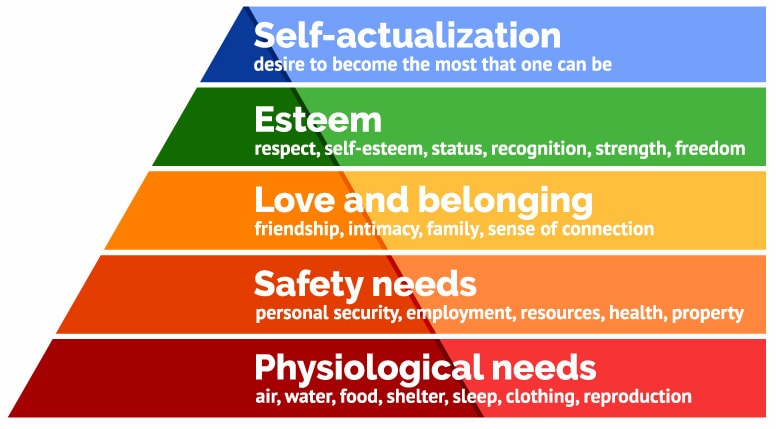
    maslow’s hierarchy of needs

    Remember Maslow’s Heirarchy of Needs?  He describes a ladder of basic, essential needs that need to be met before being able to focus on higher needs and pursuits. This pandemic has put us all at the Safety and Survival levels with a stark difference emerging between those who were living paycheck to paycheck and those with a bit of a nest egg.  I feel privileged to be able to shelter in a nice place with family I love. In reality, I am safe and secure. But many are not. My worldview has shifted to one of inter-being,  my “me” has become more of a me + we. Dr. Dan Seigel calls this recognition of our interconnectedness” m-we.” On that level, I feel the pain and fear and grief that is a palpable part of the collective. But knowing this interconnection, I also know that when I keep my peace, I am keeping the peace for all. Notice how this works in your household if you don’t believe me!

    The definition of stress is anything that requires adaptation. This pandemic has required us to adapt in every way. Major life stressors include illness, job insecurity or loss, housing insecurity or loss, relationship issues, loss of social connection and grief.   So much change in so little time! This level of change is very taxing on our nervous systems. The adrenal glands are working overtime to assist the body in maintaining some kind of normal known as homeostasis. When faced with major stressors, the body over time, has a harder time maintaining health thus the fatigue.  Choosing some kind of routine self care is critical right now.

    Nourish Yourself

    I’d like to share my approach to coping that involves the concept of nourishment and “befriending the nervous system” as Deb Dana, LCSW and Polyvagal Theory expert teaches. I ask every new client if they feel well-nourished. Most stop and pause and have to think. I always get a very honest answer. Many say no,”I know I can take better care of myself.” Many list other ways of nourishing themselves than food, such as taking a bath or reading something soul-full or spending time in nature. We are being inundated with resources, online entertainment options, work requests, family requests, and on and on. By honoring your needs and letting your nervous system guide you to make the optimal choices to nourish yourself you send the message of safety to your brain. This allows you to shift out of fight or flight and into rest and repair mode, keeping all your systems (including the immune system!) functioning optimally.

    The concept is simple and involves the following:

    • Tune into your body. It is your built in guide. How does it feel? Ask what the body needs, in this moment or maybe that day. Don’t get too far ahead. More rest, more movement, some specific food?
    • Do a simple test and feel how the words Yes and No feel in the body. No usually gets some kind of a contracting feeling. Yes is an opening.
    • Before you choose anything, even if it is something that is supposed to be good for you,  check in with yourself and see if it’s a Yes or a No.
    • If in doubt or anxious, focus your awareness on your heart and do slow deep breathing while bringing to mind something or someone you are grateful for. This aligns your mind and body and relaxes the nervous system and will allow for more clear guidance. The brain can easily become  hijacked by fear,  let the heart lead the way!

    Please see other recent posts on sleep, your stress personality and ways to relax and care for the nervous system and yourself. How will you take care of yourself today?

  • Microsoft Innovations: Empowering the Mobile Experience

    Microsoft is a global technology leader, constantly driving innovation and transforming the digital landscape. With cutting-edge mobile applications and cloud solutions, the company enables users to work, learn, and enjoy entertainment wherever they are.

    Innovative Solutions for Business and Personal Use

    Products such as Office 365 and the Azure platform have revolutionized the way both businesses and individuals operate. Microsoft’s mobile solutions provide seamless access to essential tools, ensuring productivity and connectivity on the go.

    Security and Reliability

    Security remains a top priority for Microsoft. Regular updates and advanced protection technologies guarantee that users’ data stays secure, whether they’re managing business tasks or accessing personal information.

    Discover More

    Committed to making technology accessible for everyone, Microsoft continues to innovate and grow. To explore the latest developments and learn more about their diverse range of products, visit the official website at Microsoft.

  • Sleep is #1 Wellness Strategy

    Sleep is #1 Wellness Strategy

    Sleep is essential for the ability of our amazing bodies to do much needed restoration and clearing. This keeps the brain, immune system, digestive track, bones and muscles all functioning optimally.  Pre-pandemic, we already had a sleep deprivation epidemic.  Add in the major life disruption, stress, added screen time and extra alcohol, I will take a guess that sleep problems will increase.

    Generally speaking, experts agree that 95 percent of adults need to sleep 7 to 9 hours each night to function optimally. 95 percent of adults who get less than 7 hours of sleep on a routine basis will experience decreased mental and physical performance. According to Harvard Medical School, The average length of time Americans spend sleeping has dropped from about nine hours a night in 1910 to about seven hours today. And according to Dr. Lawrence Epstein at Harvard Medical School, 20 percent of Americans (1 in 5) get less than six hours of sleep per night.

    Most adults should be aiming for eight hours per night. Children, teenagers, and older adults typically need even more.

    Why is sleep so important?

    There are two parts of the sleep-wake cycle.

    • The slow wave or deep sleep is when the body does its repair and restore tasks. Tissue growth and muscle and the immune system repair happen during this phase.
    • REM sleep or Rapid Eye Movement phase. REM sleep is for dreaming, re-organizing information, boosting your memory and facilitating learning and brain growth.
    • Without both phases, your body literally starts to die. Chronic sleep deprivation leads to weight gain, diabetes, high blood pressure, mental illness, increase infections and higher mortality.

    20 percent of Americans (1 in 5) get less than six hours of sleep per night.

    The Circadian Rhythm

    Here are some key points in the typical 24-hour cycle:

    • 6 A.M.       Cortisol levels increase to wake your brain and body
    • 7 A.M.       Melatonin production stops
    • 9 A.M.       Sex hormone production peaks
    • 10 A.M.     Mental alertness levels peak
    • 2:30 P.M. Best motor coordination
    • 3:30 P.M. Fastest reaction time
    • 5 P.M.       Greatest cardiovascular efficiency and muscle strength
    • 7 P.M.       Highest blood pressure and body temperature
    • 9 P.M.       Melatonin production begins to prepare the body for sleep
    • 10 P.M.     Bowel movements suppressed as the body quiets down
    • 2 A.M.      Deepest sleep
    • 4 A.M.      Lowest body temperature

    The Circadian rhythm is impacted by 3 main factors:  light, time and melatonin or the sleep hormone.

    How To Sleep Better


    • Avoid caffeine: Some people metabolize caffeine slowly so even a morning cup of coffee can affect your sleep.  A good rule if you really can’t cut caffeine is No coffee after noon.
    • Limit alcohol: Yes, it helps some fall asleep but it interferes with your deep sleep and delays the REM cycle.  It can also lead to blood sugar dip, which will wake you up.
    • Expose yourself to morning sunlight. During the winter, consider buying a sunlamp to simulate morning sunlight. http://www.sunbox.com
    • Use the bedroom for sleep and sex only. Eliminate all screens from the bedroom.
    • Set a screen (TV, computer, phone) curfew for 2 hours before you want to go to sleep. Download free software https://justgetflux.com or an app called f.lux which reduces the blue light of your screen.  Some people wear amber colored glasses while watching TV or using the computer.  Cover any digital light from alarm clocks/etc.
    • Stick to a regular schedule
    • Unwind before you go to sleep. Write down whatever is on your mind whether it is a to do list or something bothering you.  Better yet, write down 3 things you are grateful for.  Studies have shown this improves sleep.
    • Exercise during the day but not later than 2-3 hours before bedtime.
    • Stretch, do yoga or just a total body relaxation before bed to rid the body of excess stress.
    • Avoid liquids 2-3 hours before bedtime.
    • Sleep in a quiet, completely dark, cool room (64-68 degrees). Use ear plugs or white noise machines and an eye mask if needed.
    • Supplements: Melatonin is OK in low doses for short term use.  It is a hormone and supplementing can throw your internal mechanism of production out of whack.  Magnesium supplements are a good choice.  Most people don’t get enough from their diet and it is non-toxic up to 800 mg.  There is a product called Natural Calm mixed in warm water before bed.  It can have a laxative effect.  True Calm and Quietude are also supplements to consider. Please check   with your health care provider when starting any new supplements.
    • Have a tsp. of honey or a ½ banana before bed. If the liver runs out of glucose over night, you will wake up.
    • Meditate by counting your breaths to 10 and then counting backwards to one.

    Making sleep a priority now will boost your immunity, improve your mood, help you lose and maintain weight,  boost your creativity and problem solving and prevent premature aging.

    “A good laugh and a long sleep are the two best cures for anything.”  

    An Irish Proverb


  • Treatment for Substance Use Disorder Kaiser Permanente

    For a more structured approach, various professional resources are available for alcohol dependency treatment. Cognitive Behavioral Therapy sober house (CBT) modifies negative thought patterns related to drinking and equips individuals with coping strategies. Medications like Naltrexone, Acamprosate, and Disulfiram can assist in managing cravings and deterring alcohol use.

    alcohol abuse recovery

    How to Recognize and Address Co-Occurring Disorders

    Start by eliminating all alcoholic beverages, barware, and reminders of drinking from your home. This not only reduces temptation but also helps to establish a fresh atmosphere that supports your commitment to sobriety. Research shows that reducing alcohol consumption lowers the risk of heart disease, enhances mood, and contributes to better sleep quality. As part of our comprehensive outpatient services, our detox program provides completely personalized care, focusing on the needs of each patient. If your doctor brings up concerns, it doesn’t mean you have a problem.

    7 Help for Drug & Alcohol Use

    Discover strategies for staying sober during the holidays, embracing alcohol-free alternatives and self-care. Discover the risks of drinking and pregnancy, guidelines, and support for a healthy journey for you and your baby. Explore top Kansas drug rehab centers, their services, and how to find the right support for recovery. Discover the qualities of effective addiction treatment centers that ensure successful and compassionate recovery. Discover how alcoholism develops over time, its impact on health, and the stages of this long-term progression.

    Is aftercare included in alcohol treatment?

    Never disregard professional medical advice or delay in seeking it because of something you have read on this website. In the event of a medical emergency, call a doctor or 911 immediately. This website does not recommend or endorse any specific tests, physicians, products, procedures, opinions, or other information that may be mentioned on the Site. Reliance on any information provided by this website is solely at your own risk.

    alcohol abuse recovery

    Setbacks Are Part of the Process

    This is a place where you can be honest about your substance use and what you want to do about it. Unlike cocaine or heroin, alcohol is widely available and accepted in many cultures. It’s often at the center of social situations and closely linked to celebrations and enjoyment. We know the ups and downs can be confusing, and may cause you to question who you really are without alcohol. Here’s a therapist’s advice on how to navigate the early recovery identity crisis.

    • This may mean making major changes to your social life, such as finding new things to do with your old drinking buddies—or even giving up those friends and finding new ones.
    • While the recovery period may be challenging, it’s also filled with milestones that can transform your life into one that’s better than you could have previously imagined.
    • Working with your Care Team will ensure your decisions are personalized and informed, and that you have resources at your fingertips whenever you need them.
    • Always seek the advice of a physician or other qualified health provider with any questions you may have regarding a medical condition.
    • What’s more frightening is when you’re the one battling a substance use disorder (SUD) or an alcohol use disorder (AUD), and you don’t have a solution to the problem.

    This pause reduces the urge to binge, important for contexts like college settings, where the pressure to drink can be intense. An awareness of such habits and triggers not only supports moderation but enhances overall well-being. Programs can range from 30 days for inpatient care to several months for outpatient programs. After completing an Alcohol Treatment Program, most individuals participate in outpatient counseling, support groups, or 12-step programs like Alcoholics Anonymous (AA).

    What health complications are associated with alcoholism?

    Maintaining these commitments makes you more likely to achieve your goals. Second, savor the positive emotions and know that with the right treatment, dedication, and self-care, you will find a sustainable path complete with authentic joy. Creating a sustainable new lifestyle without or with less alcohol requires navigating both highs and lows. Growth happens in discomfort, and it’s important to recognize challenging moments as learning opportunities. Mark’s key responsibilities include handling day-to-day maintenance matters and oversees our Environment of Care management plan in conjunction with Joint Commission and DCF regulations. Mark’s goal is to provide a safe environment where distractions are minimized, and treatment is the primary focus for clients and staff alike.

    Ways Life Gets Better After You Stop Drinking

    Combined with treatment led by health care providers, mutual-support groups can offer a valuable added layer of support. Three medications are currently approved in the United States to help people stop or reduce their drinking and prevent a return to drinking. These medications are prescribed by a primary care provider or other health care provider and may be used alone or in combination with counseling.

    By avoiding environments where drinking is common, such as bars or parties, you can minimize exposure to temptation. Setting clear limits on alcohol intake is essential for managing consumption. For women and older men, the guideline suggests no more than one drink per day, while younger men may have up to two. https://appsychology.com/living-in-a-sober-house/ This establishes a foundation for healthier drinking patterns and serves as a guiding structure to avoid overindulgence. Traditional addiction treatment is based primarily on counseling. Many Drug Treatment Boston facilities also offer ongoing services to help individuals stay on track.

  • Neuro Hacks for COVID-19 Fear

    Neuro Hacks for COVID-19 Fear

    We Are Wired For Fear

    It is hard not to get caught up in the media fear frenzy surrounding coronavirus. The oldest part of our brain that is in charge of keeping us alive is on high-alert!  Back in the day when our biggest threat was a tiger, our brain would scan our environment for signals of danger, report to our body via an interconnected messenger system how to respond – stay put, fight, run or in the worst case scenario, freeze and play dead.  Our brain is wired to fixate on the negative and potential dangers to keep us safe.

    Constantly searching for new information in the hopes of feeling some control only keeps us in this hyper-vigilant reactive response. Knowing that our immune system is directly linked to how much stress we are experiencing, it becomes actually harmful to our health to stay in the this cycle. Social distancing may be necessary to stop the spread of the virus but it is important to stay socially connected to keep your immune system working properly!

    That soothing voice, a gentle touch, gives our nervous system the cue to relax, “I am safe here.“

    How Do We Break The Cycle

    It is good news that our nervous system evolved to include the Social Engagement System.  This system is designed to evoke the feelings of safety through a calm voice, friendly, empathetic facial expressions and gestures.  Think of a mother in tuned with her child who comes for comfort after being hurt or scared.  That soothing voice, a gentle touch, gives our nervous system the cue to relax, “I am safe here.”

    The following are neuroscience based suggestions to keep you calm:

    1. Observe and notice when you get caught up in the fear frenzy. Learn what you need to do to keep yourself and loved ones healthy and then turn off the media.
    2. Tell a friend or family member about the Social Engagement System. Have a stress-free zone at home or with each other where you can give each other signals of safety – laugh, smile, talk in a calm voice. Try FaceTime or Zoom if we end up being isolated for longer periods of time. Social distancing doesn’t have to mean complete isolation. Be creative to find ways to connect. Staying calm yourself is literally contagious.
    3. Since the brain sticks to the negative, it takes conscious awareness and intention to notice and amplify the positive.  I suggest setting an alarm on your phone to take a gratitude break. This brings you into the present moment and gives your brain a task to find something positive. Better yet, share your gratitude.
    4. Savor the positive, it takes repeated focus to create new neural pathways so have something in sight that can be a reminder of what you love or are grateful for – a photo of loved ones or a favorite place, a flower, a shell from the ocean, an inspirational quote.
    5. Create a powerful healing state called coherence by doing a quick heart-centered breath technique that calls for a 4 count inhale, 6 count exhale and really feel and focus on something you love or are grateful for.  There is an app and sensor you can get named Inner Balance (Heart Math Institute) that shows you in real-time if you are in the relaxed mode of your nervous system which is call Rest and Repair or Rest and Digest by the way.
    6. Help others in need.

    We Are Also Wired for Love and Bliss

    Where do we go from here?  We approach this challenge like any other. We use that Social Engagement System to spread peace. What is the opportunity for growth and responding with love and kindness? We may get sick, we heal, we take care of others. We provide niches of safety to those who are in fear.  We count our blessings and notice the weaknesses in our country’s health care system (more of a sick care system), and our economy. We notice how we are a global community, so we heal together and solve our problems together. We are as Thich-Naht Hahn says, Inter-Being. Our nervous systems are not only wired for fear and love but also Bliss. This bliss is accessible in the silence of the heart. Dropping into this space turns on the part of our brain that gives us the feeling of oneness and being deeply held.  You won’t find that on social media. Wisdom and answers emerge from that space.  It’s already there, waiting for you to show up.

  • Microsoft Innovations: Empowering the Mobile Experience

    Microsoft is a global technology leader, constantly driving innovation and transforming the digital landscape. With cutting-edge mobile applications and cloud solutions, the company enables users to work, learn, and enjoy entertainment wherever they are.

    Innovative Solutions for Business and Personal Use

    Products such as Office 365 and the Azure platform have revolutionized the way both businesses and individuals operate. Microsoft’s mobile solutions provide seamless access to essential tools, ensuring productivity and connectivity on the go.

    Security and Reliability

    Security remains a top priority for Microsoft. Regular updates and advanced protection technologies guarantee that users’ data stays secure, whether they’re managing business tasks or accessing personal information.

    Discover More

    Committed to making technology accessible for everyone, Microsoft continues to innovate and grow. To explore the latest developments and learn more about their diverse range of products, visit the official website at Microsoft.

  • Microsoft Innovations: Empowering the Mobile Experience

    Microsoft is a global technology leader, constantly driving innovation and transforming the digital landscape. With cutting-edge mobile applications and cloud solutions, the company enables users to work, learn, and enjoy entertainment wherever they are.

    Innovative Solutions for Business and Personal Use

    Products such as Office 365 and the Azure platform have revolutionized the way both businesses and individuals operate. Microsoft’s mobile solutions provide seamless access to essential tools, ensuring productivity and connectivity on the go.

    Security and Reliability

    Security remains a top priority for Microsoft. Regular updates and advanced protection technologies guarantee that users’ data stays secure, whether they’re managing business tasks or accessing personal information.

    Discover More

    Committed to making technology accessible for everyone, Microsoft continues to innovate and grow. To explore the latest developments and learn more about their diverse range of products, visit the official website at Microsoft.

  • Microsoft Innovations: Empowering the Mobile Experience

    Microsoft is a global technology leader, constantly driving innovation and transforming the digital landscape. With cutting-edge mobile applications and cloud solutions, the company enables users to work, learn, and enjoy entertainment wherever they are.

    Innovative Solutions for Business and Personal Use

    Products such as Office 365 and the Azure platform have revolutionized the way both businesses and individuals operate. Microsoft’s mobile solutions provide seamless access to essential tools, ensuring productivity and connectivity on the go.

    Security and Reliability

    Security remains a top priority for Microsoft. Regular updates and advanced protection technologies guarantee that users’ data stays secure, whether they’re managing business tasks or accessing personal information.

    Discover More

    Committed to making technology accessible for everyone, Microsoft continues to innovate and grow. To explore the latest developments and learn more about their diverse range of products, visit the official website at Microsoft.